Issue 23, 2025

Anionic 5-endo-dig cyclizations: an experimental investigation of in-plane aromaticity involving a non-enolate carbanion nucleophile

Abstract

Cyclitive additions of aliphatic carbanions to non-electrophilic carbon–carbon triple bonds under mild, transition-metal-free conditions are described for the first time. These results confirm theoretical models that invoke in-plane aromaticity to predict the favorability of 5-endo-dig reactions in these systems. In contrast to related Conia-ene cyclizations (5-enolexo-endo-dig), our results generally led to cyclic and allene products in near parity ratios across a broad range of substrates, suggesting that cyclization may proceed via an early ambimodal transition state. Experimental results are presented with a view to refining existing mechanistic models for this growing class of alkyne reactions.
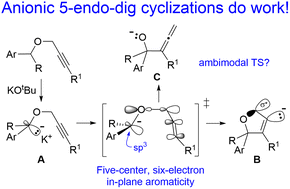
Graphical abstract: Anionic 5-endo-dig cyclizations: an experimental investigation of in-plane aromaticity involving a non-enolate carbanion nucleophile

Supplementary files

Article information

Article type
Tutorial Account
Submitted
20 Mar 2025
Accepted
25 Jul 2025
First published
01 Aug 2025
This article is Open Access
Creative Commons BY-NC license

Org. Chem. Front., 2025,12, 6609-6613

Anionic 5-endo-dig cyclizations: an experimental investigation of in-plane aromaticity involving a non-enolate carbanion nucleophile

K. M. Nugent, S. Q. Hintze, P. Maity and S. D. Lepore, Org. Chem. Front., 2025, 12, 6609 DOI: 10.1039/D5QO00547G

This article is licensed under a Creative Commons Attribution-NonCommercial 3.0 Unported Licence. You can use material from this article in other publications, without requesting further permission from the RSC, provided that the correct acknowledgement is given and it is not used for commercial purposes.

To request permission to reproduce material from this article in a commercial publication, please go to the Copyright Clearance Center request page.

If you are an author contributing to an RSC publication, you do not need to request permission provided correct acknowledgement is given.

If you are the author of this article, you do not need to request permission to reproduce figures and diagrams provided correct acknowledgement is given. If you want to reproduce the whole article in a third-party commercial publication (excluding your thesis/dissertation for which permission is not required) please go to the Copyright Clearance Center request page.

Read more about how to correctly acknowledge RSC content.

Social activity

Spotlight

Advertisements