


 PLATFORM UPDATE:


Highly active superoxide dismutase mimic: pyridine carboxamide-based copper(ii) complexes
 b
Ilenia
Serra,
bd
Nóra V.
May,
f
Erzsébet
Fekete,
c
Levente
Karaffa,
c
István
Fábián,
ae
Sabine
Van Doorslaer
*b
and
Norbert
Lihi
*ae
b
Ilenia
Serra,
bd
Nóra V.
May,
f
Erzsébet
Fekete,
c
Levente
Karaffa,
c
István
Fábián,
ae
Sabine
Van Doorslaer
*b
and
Norbert
Lihi
*ae
Abstract
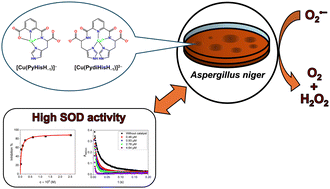
Pyridine-based ligands functionalized with one (PyHis) or two histidine (PydiHis) moieties were synthesized, and their copper(II) complexes were studied as novel antioxidant systems. The complexes were characterized by pH-potentiometric, spectroscopic (UV-vis, circular dichroism, continuous-wave and pulsed electron paramagnetic spectroscopy (EPR)), computational (DFT) and X-ray diffraction methods. The complexes show high thermodynamic stability. The PyHis complex possesses a (COO−,Npy,N−,NIm) donor set, while PydiHis binds copper(II) via a (NIm,Npy,N−,NIm) donor set at physiological pH. The PyHis and PydiHis complexes of copper(II) exhibit negligible (IC50 = 147 ± 15 μM) and outstanding (IC50 = 0.64 ± 0.07 μM) superoxide dismutase (SOD) activity, respectively. The noted difference is attributed to the structural flexibility of the latter complex as confirmed by pulsed EPR spectroscopy. The antioxidant activity of the copper(II) complexes was also tested in vivo by monitoring their effects on the mycelial growth of Aspergillus niger under oxidative stress. Both complexes were able to protect the cells under these conditions; however, the copper(II) complex of PydiHis was more effective in accordance with its excellent SOD activity. Consequently, the copper(II) complex of PydiHis stands out as an efficient, low-molecular-weight SOD mimic combining high catalytic activity with proven biological efficacy under oxidative stress conditions, making it a promising candidate for medical applications.
 Please wait while we load your content...


