


 PLATFORM UPDATE:


Engineering solid-state structural transformations and reactions in complexes containing a natural alkaloid for specific switchable properties
 a
Marko
Dunatov,
a
Andreas
Puškarić,
a
Glorija
Medak,
a
Robert
Kruk
b
and
Lidija
Androš Dubraja
*a
a
Marko
Dunatov,
a
Andreas
Puškarić,
a
Glorija
Medak,
a
Robert
Kruk
b
and
Lidija
Androš Dubraja
*a
Abstract
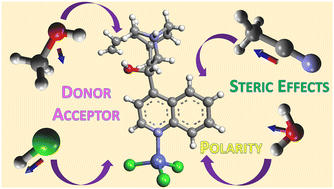
Molecule-based crystals that respond to environmental stimuli such as light, temperature, pressure, electricity and humidity are attractive candidates for smart materials, i.e. sensors, actuators, optoelectronic devices, information storage, medical applications, etc. The design strategies for stimuli-responsive molecular materials are based on the interplay between weaker intermolecular interactions and flexible constituent units, e.g. pseudo-spherical organic cations and halogenometalate anions. In this context, solid-state structural transformations of a metal complex containing a natural alkaloid with a quasi-spherical fragment, the cinchoninium–trichloro–cobalt(II), were investigated under the influence of various stimuli. The cinchoninium-trichloro-cobalt(II) complex was dynamically modified post-synthetically by exposing it to (i) different small molecules in the vapour phase (water, methanol, acetonitrile, hydrochloric acid) or (ii) grinding conditions with small molecules (mechanochemical reaction), resulting in six different crystal phases. The structural transformations, their reversibility and selectivity towards small molecules were investigated by a combination of vacuum infrared spectroscopy and powder X-ray diffraction methods, supported by single-crystal X-ray diffraction analysis. The study of the effects of exposure to solvent molecules either in the vapour phase or by post-synthetic grinding on the crystal structure of the final product provided insights into the control of crystallographic symmetry (enhancement or breaking) and an understanding of the origin of the resistive sensing and static magnetic properties in the cinchonine–chloro–cobalt(II) system.
 Please wait while we load your content...


