


 PLATFORM UPDATE:


Design and synthesis of aculeatin oxo-analogues and aculeatin natural products enabled by oxo-carbenium ion cyclization

Abstract
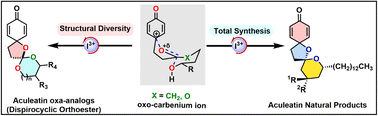
Aculeatin natural products are potent anti-protozoal agents isolated from Amomum aculeatum, demonstrating high cytotoxicity against KB cell lines (IC50 = 0.9–2.0 μM) and exceptional activity against Plasmodium falciparum strain K1 (IC50 as low as 0.18 μM). We report a novel cascade methodology for the collective total synthesis of aculeatins A, B, D, E, and F, alongside their unnatural oxo-analogs. The strategy utilizes phenyliodine(III) diacetate (PIDA)-mediated oxidative dearomatization of phenol derivatives to form a transient, bifunctional electrophilic spiroacetal oxo-carbenium ion and further reaction with diols. The major advance was the development of an intramolecular protocol that delivered significantly higher efficiency (up to 92% yield) and superior reaction control compared with our previously reported intermolecular variant. Comprehensive mechanistic investigations, including control experiments and computational studies, confirmed the involvement of the spiroacetal oxo-carbenium ion intermediate in this transformation.
 Please wait while we load your content...


