


 PLATFORM UPDATE:


Accelerating innovation in peptide synthesis through continuous-flow

Abstract
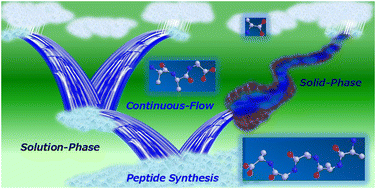
Peptide-based pharmaceuticals, a representative class of medium-sized molecule drugs, have now surpassed 110 approved compounds. Their significance is also increasing in fields such as agrochemicals and functional materials. Consequently, there is a strong demand for chemical synthesis methods that generate less waste, require shorter reaction times, are more cost-effective, and utilize reagents and solvents with lower environmental impact. For more than half a century, continuous-flow synthesis—where the reaction takes place within a flow channel—has been applied to peptide synthesis, leading to remarkable advancements. Today, rapid synthesis of peptides exceeding 200 residues, one-flow multi-component coupling for rapid peptide chain elongation, and GMP-compliant kilogram-scale peptide production have been achieved using both solid-phase and solution-phase continuous-flow synthesis techniques. Furthermore, various strategies have been proposed to address issues related to waste generation, time, cost, and environmental burden. This review focuses on recent developments over the past four years, categorizing topics into solid-phase and solution-phase peptide chain elongation, peptide cyclization, and peptide coupling, and discusses the remaining challenges and future perspectives.
 Please wait while we load your content...


