


pH related activity and reaction mechanism of CatA: a DFT study
 a
and
Nurcan Ş.
Tüzün
*a
a
and
Nurcan Ş.
Tüzün
*a
Abstract
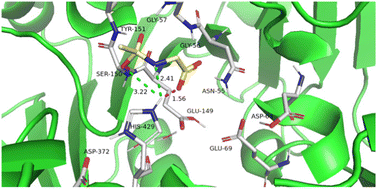
Cathepsin A (CatA) is a human serine type carboxypeptidase enzyme which functions optimally around pH 4–5 and displays deamidase/esterase activity at elevated pH levels around 7–8. The activity of CatA is associated with key biological processes and CatA has emerged as a potential drug target. The pH-dependent activity of CatA was attributed to the pH regulator Glu149-Glu69 amino acid pair in the active site. In the literature, the kinetics of CatA have been investigated and pH-dependent enzyme mechanisms have been proposed. In this study, a quantum cluster approach with DFT calculations was employed to investigate the geometries and energetics of the enzymatic reaction and gain insight into the pH-dependent carboxypeptidase mechanism of CatA. To mimic different pH conditions, the critical residues and the model substrate were modelled at various protonation states. Under high pH conditions, the reaction mechanisms had the highest barriers, and this was attributed to deactivation of the C-end binding site of the enzyme leading to unorthodox substrate binding modes. The experimental low pH deactivation was accounted for by the low enzyme–substrate binding when the substrate C-end was protonated. It was determined that optimal pH conditions were achieved when three of the Glu69, Glu149, Asp64 and substrate C-end were protonated. It is hypothesised that two adjacent low-barrier hydrogen bonds are formed between the substrate/Glu149 and Glu149/Glu69 pairs at the carboxylate binding site when the substrate's anionic C-end is bonded to CatA's C-end binding site, under optimum pH conditions.
 Please wait while we load your content...


