


 PLATFORM UPDATE:


Diastereoselective amidoboronate formation and transformation from a rac to a different meso amidoboronate via dynamic C–C bonds

Abstract
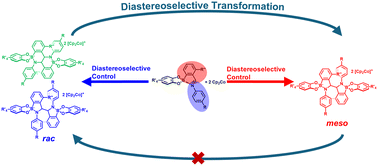
Amidoboronates, synthesized through the reductive coupling of iminoboronates with cobaltocene in DMSO, form as mixtures of up to three isomers (rac5, rac6 and meso5) and can exhibit up to three types of dynamic covalent bonds (C–C, B–N, B–O). In order to exploit the reductive coupling for the self-assembly of covalent organic macrocycles and cages, control over the diastereoselectivity and reversibility of C–C bond formation is required. We report proof-of-principle in dimeric amidoboronates; diastereoselective rac isomer formation was observed for amidoboronate 5e (based on p-NMe2-substituted aniline, pyrocatechol and phenylboronate), whereas employing an iminoboronate containing p-OMe-substituted aniline, either pyro- or tetrachlorocatechol and 3-fluorophenylboronate led to rare examples of meso diastereoselectivity (9 : 1 dr for 7d and 8d). The addition of a second iminoboronate to amidoboronate reaction mixtures probed the reversibility of C–C bond formation as evidenced by the formation of new homo- and cross-coupled amidoboronates via exchange. The dynamic covalent C–C bonds were exploited in the unprecedented diastereoselective transformation of rac5/6-5e to meso5-7d following addition of excess iminoboronate 3d.
 Please wait while we load your content...


