


 PLATFORM UPDATE:


Efficient synthesis of quinazolinones through base promoted dehydrocyclization using a copper(ii) catalyst
Abstract
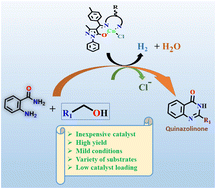
Two keto-pyrazole based ligands (2a, 2b) having an N^N^O chelating Schiff base and their Cu(II) complexes, (Z)-5-methyl-2-phenyl-4-((quinolin-8-ylimino)(p-tolyl)methyl)-pyrazol Cu(II) chloride (3a) and (Z)-5-methyl-2-phenyl-4-(((pyridin-2-ylmethyl)imino)(p-tolyl)methyl)-2-pyrazol Cu(II) chloride (3b), are reported here. Single-crystal X-ray diffraction analysis confirms a four-coordinate square planar environment around the Cu(II) centre. The complexes act as catalysts, facilitating the dehydrogenation of primary alcohols with aminobenzamides to form quinazolin-4(3H)-one cores. The optimized catalytic system demonstrates broad substrate tolerance and high functional group compatibility, delivering products in excellent yields (up to 96%). Mechanistic investigations, including mercury poisoning tests and HRMS analysis, validate a non-radical, two-electron hydride transfer pathway for alcohol dehydrogenation. This sustainable method utilizes readily available Earth-abundant phosphine-free copper catalysts, providing a practical and environmentally benign route to synthesize biologically significant N-heterocycles.
 Please wait while we load your content...


