


 PLATFORM UPDATE:


New carborane–BODIPY conjugates: synthesis, photochemical properties and tumor cell photodamage
 a
Alina A.
Markova,
b
Minh Tuan
Nguyen,
b
Vladimir A.
Kuzmin,
b
Valentina A.
Ol'shevskaya
*a
a
Alina A.
Markova,
b
Minh Tuan
Nguyen,
b
Vladimir A.
Kuzmin,
b
Valentina A.
Ol'shevskaya
*a
Abstract
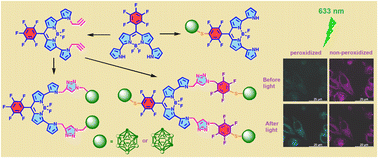
4,4-Difluoro-4-bora-3a,4a-diaza-s-indacene systems (BODIPY) are widely investigated fluorophores. The BODIPY core allows for introducing substituents at different positions. Taking advantage of the versatile properties of carborane cages for the modification of photoactive compounds, we developed the synthesis of carborane-substituted BODIPYs. The regioselective nucleophilic SNAr aromatic substitution of the para-fluorine atom in 3,5-dipyrrolyl-8-pentafluorophenyl BODIPY 1 with 9-mercaptocarboranes yielded 8-carborane-substituted BODIPYs. Furthermore, the CuAAC reaction of BODIPY propargyl-substituted pyrroles with carboranylazides afforded boronated BODIPY triazoles. Derivatives with m-carboranyl substituents accumulated in HCT116 cells but lost their fluorescence, whereas o-carboranyl analogues retained fluorescence, an effect attributable to a higher affinity toward albumin and phospholipid-derived liposomes. Laser confocal microscopy analyses demonstrated that selected mono- and dicarboranyl derivatives induced lipid peroxidation upon 633 nm light illumination, leading to non-necrotic cell death. These features of cell photodamage were attributed to the ability of the carborane moiety to prevent aggregation of the BODIPY containing compounds in aqueous media and to spatially limit lipid peroxidation, thereby preserving membrane integrity. Thus, closo-carboranyl substituents at the BODIPY core differentially modulate the fluorescent properties and the photodamaging potency of conjugates.
 Please wait while we load your content...


