


Stable 1T″ HfCl2 monolayer with strong excitonic effects and promising solar harvesting efficiency
 a
Celso R. C.
Rêgo,
d
Diego
Guedes-Sobrinho,
f
Alexandre
Cavalheiro Dias
g
and
Maurício Jeomar
Piotrowski
*a
a
Celso R. C.
Rêgo,
d
Diego
Guedes-Sobrinho,
f
Alexandre
Cavalheiro Dias
g
and
Maurício Jeomar
Piotrowski
*a
Abstract
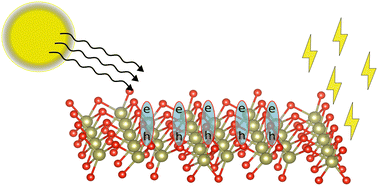
In this work, we performed a computational screening of group IV transition-metal dihalide monolayers in the recently proposed 1T″ phase. We have thoroughly examined their structural, electronic, optical, and excitonic characteristics, using density functional theory with both the generalized gradient approximation (PBE) and hybrid (HSE06) exchange–correlation approaches including spin–orbit coupling, complemented by Wannier-function-based tight-binding and Bethe–Salpeter equation analyses; as well as phonon dispersion calculations and ab initio molecular dynamics to shed light on the material stability. Out of the nine candidate systems, only 1T″ ZrCl2, HfCl2, and HfBr2 were found to be dynamically and thermally stable, with semiconducting behavior observed exclusively for HfCl2. From a detailed analysis of this compound, we have revealed pronounced excitonic effects, with a binding energy of 275 meV, strong optical anisotropy, and broadband absorption covering the infrared, visible, and ultraviolet ranges. Moreover, efficiencies of up to 20% were obtained by evaluating the 1T″-HfCl2 photovoltaic performance using the spectroscopic limited maximum efficiency and the Shockley–Queisser limit. These results highlight 1T″-HfCl2 as a promising two-dimensional semiconductor for optoelectronic and solar energy applications.
 Please wait while we load your content...


