


 PLATFORM UPDATE:


Defect engineering in OH-functionalized carbon nanotubes for visible-light-driven ROS-mediated anticancer therapy and high-performance photocatalysis
 *c
and
Seungwoo
Hong
*ab
*c
and
Seungwoo
Hong
*ab
Abstract
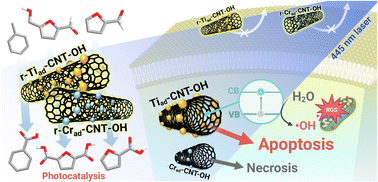
Carbon nanotube (CNT)-based therapies are emerging as powerful tools in oncology due to their ability to selectively target cancer cells while minimizing damage to healthy tissues. Leveraging the critical role of reactive oxygen species (ROS) in cancer progression, this study explores ROS-mediated photodynamic strategies to enhance therapeutic efficacy. We present a systematic design of five CNT derivatives—CNT-OH, Ti-doped CNT-OH, NaBH4-treated Ti-doped CNT-OH, Cr-doped CNT-OH, and NaBH4-treated Cr-doped CNT-OH—engineered to improve visible light absorption and photocatalytic activity. Our approach introduces two key innovations: transition metal doping to create oxygen vacancies that boost light responsiveness and NaBH4 treatment to induce structural defects and elevate surface charge. These modifications not only fine-tune the physicochemical properties of CNTs but also modulate their biological interactions. Ti-doped CNTs exhibit efficient internalization into renal cancer cells and trigger apoptosis under visible light, offering a controlled and targeted therapeutic mechanism. In contrast, Cr-doped CNTs induce necrosis, likely due to inherent cytotoxicity, highlighting the importance of material composition in cell fate decisions. Furthermore, we demonstrate the dual applicability of these CNTs in sustainable photocatalysis. NaBH4-treated Cr-doped CNT-OH shows superior photocatalytic conversion of furfuraldehyde, 5-hydroxymethylfurfural, and toluene, attributed to its optimized surface properties. This work underscores the potential of defect-engineered CNTs as multifunctional platforms for both advanced cancer therapy and sustainable chemical transformation.
 Please wait while we load your content...


