


 PLATFORM UPDATE:


Optimized loading of Pt single atoms from platinic acid solution and the sweet spot for activity
 ab
Patrik
Schmuki
*ab
ab
Patrik
Schmuki
*ab
Abstract
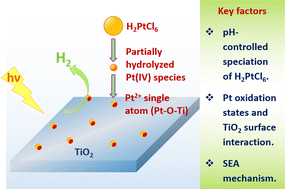
In recent years, platinum single atoms (SAs) have emerged as exceptionally efficient co-catalysts for photocatalytic hydrogen (H2) evolution. In the present work, we systematically investigate the solution parameters that govern the deposition of Pt SAs from dilute H2PtCl6 precursors onto well-defined sputtered anatase TiO2 thin films and evaluate the effect on photocatalytic H2 evolution. We show that both precursor concentration and solution composition critically determine the oxidation state, dispersion, and reactivity of surface-bound Pt species. Ultra-dilute, additive-free solutions (0.001–0.005 mM) enable strong electrostatic adsorption (SEA) and aquation-assisted anchoring of isolated Pt2+ atoms, leading to atomically dispersed Pt–O–Ti surface motifs with maximal H2 evolution per Pt. In contrast, increased ionic strength or unfavorable speciation caused by higher concentration or pH adjustment induces non-selective uptake, formation of Pt(IV)-rich 2D rafts, and diminished catalytic performance. Overall, we show that the placement and photocatalytic activity of Pt SAs are dictated by the pre-reaction deposition chemistry. From a practical view, this study defines a narrow yet actionable parameter window for scalable, efficient SA co-catalyst decoration and establishes the mechanistic basis for performance optimization via precursor-chemistry design.
 Please wait while we load your content...


