


 PLATFORM UPDATE:

Cellulose nanopaper with polymeric nanoparticle additives – what is the role of nanoparticle surface functionality?
 ac
and
Eva
Malmström
*abc
ac
and
Eva
Malmström
*abc
Abstract
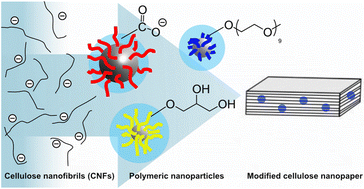
Polymeric nanoparticles with tunable surface functionalities were synthesized via polymerization-induced self-assembly (PISA) to study their interactions with TEMPO-oxidized cellulose nanofibrils (TO-CNFs) in wet and dry states. The nanoparticles possessed a rigid core and shells featuring anionic, polyethylene glycol (PEG)-like, and hydroxyl-rich functionalities, with different hydrogen bonding propensities, water binding, and glass transition temperatures. Hydroxyl-functional nanoparticles exhibited enhanced and irreversible adsorption onto CNFs compared to anionic and PEG-like functions, showing that shell functionality impacts the adsorption behavior in the wet state. In the dry state, shell functionality plays a minor role in the bulk mechanical properties, which depend instead on the nanoparticle amount. This work shows that additive interactions between colloidal components in water do not translate to interactions in the dry state.
 Please wait while we load your content...


