


An Rh–Au nanocluster protected by an N-heterocyclic carbene: synthesis, structure, and single-molecule conductance properties

Abstract
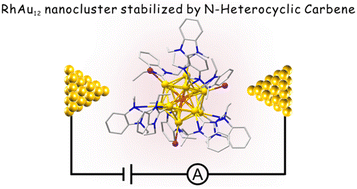
Atomically precise metal nanoclusters protected by N-heterocyclic carbenes (NHCs) constitute an emerging frontier in nanoscience, yet alloy cluster systems remain underexplored. In this work, we report the synthesis of an atomically defined gold–rhodium (Au–Rh) alloy nanocluster stabilized by NHC ligands. Its composition and structure were unambiguously determined through single-crystal X-ray diffraction, high-resolution mass spectrometry, and X-ray photoelectron spectroscopy. Systematic characterization revealed its ultraviolet-visible absorption and photoluminescence properties. Leveraging these optical characteristics, we investigated photo-modulation of electrical conductivity at the single-cluster level. Notably, 290 nm illumination induced a 338% increase in conductivity in the single-cluster junction compared to the dark state. Variable light-power experiments attributed this phenomenon mechanistically to light-induced localized surface plasmon resonance. This study proposes a design strategy for photo-responsive heterometallic cluster materials in optoelectronic applications.
 Please wait while we load your content...


