


 PLATFORM UPDATE:


Integration of H2-activating metal clusters with metal oxides for boosting the low-temperature reverse water–gas shift reaction

Abstract
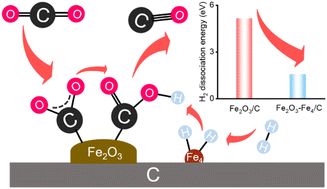
The reverse water–gas shift (RWGS) reaction provides an important pathway for converting CO2 to CO, which can then be used to produce high-value chemicals through Fischer–Tropsch synthesis. Metal oxide materials, especially Fe2O3, offer considerable potential for use in the RWGS reaction at high temperatures, but their catalytic performance is hindered by the inadequate activation and dissociation capabilities of H2 at low temperatures. Herein, we report the introduction of Fe4 with high H2 activation capability near Fe2O3, which shows a synergistic effect and achieves excellent activity and selectivity in the RWGS reaction at low temperatures. Fe2O3 nanoparticles and Fe4 clusters supported on carbon (Fe2O3–Fe4/C) were prepared via KCl-assisted pyrolysis of NH2-MIL-88B(Fe) precursors. Fe2O3–Fe4/C delivers a remarkable CO selectivity of 99.4% and a space–time yield of 15.2 μmolCO gcat−1 s−1 at 350 °C under atmospheric pressure. In situ diffuse reflection infrared Fourier-transform spectra and density functional theory calculations demonstrate that the introduction of Fe4 clusters can activate H2 and significantly lower the reaction energy barrier of CO2 hydrogenation on Fe2O3 sites, thus boosting the RWGS performance at low temperatures.
 Please wait while we load your content...


