


 PLATFORM UPDATE:

Effect of titanium–copper co-substitution in O3-type layered oxide cathodes on the electrochemical performance of sodium-ion batteries
 *a
*a
Abstract
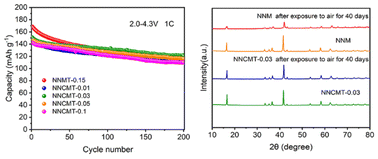
Sodium-ion batteries (SIBs) are considered the best alternatives to lithium-ion batteries (LIBs) for energy storage owing to their abundant sodium resources and low cost. O3-type layered transition metal oxides (NaxTMO2) have been considered as a promising cathode material for SIBs. However, the irreversible phase transition is a concerning challenge for O3-type layered oxides. Here, a Cu/Ti co-substituted NaNi0.47Cu0.03Mn0.35Ti0.15O2 (NNCMT-0.03) cathode is investigated. Results show that the NNCMT-0.03 cathode exhibits a homogeneous phase transition, specific capacity of 150.93 mAh g−1 at 1 C, high cycle stability with capacity retention of 80.02% at 1 C in the range of 2.0–4.3 V after 200 cycles and excellent air stability with a single O3 phase after exposure to air for 40 days. Here, the substitution of Mn4+ with Ti4+ can increase the Mn3+/Mn4+ ratio, enhance the redox reaction of Mn3+/Mn4+ and improve the specific capacity of the cathode. The high electronegativity of Cu2+ leads to a negative charge shift from the lattice oxygen to the TM ions, which greatly contributes to air stability, rate performance and good diffusion kinetics. The strategy might inspire the design and development of excellent cycling stability and high-energy density cathodes for SIBs.
 Please wait while we load your content...


