


 PLATFORM UPDATE:


Acoustic phonon-restricted four-phonon interactions: impact on thermal and thermoelectric transport in monolayer h-NbN
 a
Ashis
Kundu
*b
a
Ashis
Kundu
*b
Abstract
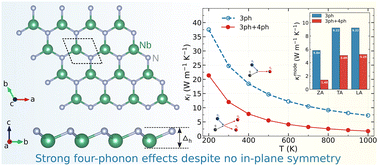
To explore the thermal and thermoelectric potential of 2D materials, we study the h-NbN monolayer, which lacks mirror symmetry and features a large acoustic-optical phonon gap and quadratic flexural mode. First-principles calculations and the Boltzmann transport formalism reveal a complex interplay of multi-phonon scattering processes, where flexural phonons and four-phonon interactions play a significant role in heat transport, primarily dominated by acoustic phonons. Notably, the four-phonon interactions are predominantly confined to acoustic phonons. Tensile strain preserves the underlying scattering mechanisms while reducing anharmonicity and, consequently, the scattering rates, enhancing thermal conduction. Simultaneously, competing modifications in thermal and electrical transport shape the strain-dependent thermoelectric response, achieving a figure of merit ∼0.70 at elevated temperatures, a testament to its thermoelectric promise. Our findings underscore the critical role of microscopic transport modeling in accurately capturing thermal and thermoelectric properties, paving the way for advanced applications of 2D materials.
 Please wait while we load your content...


