


 PLATFORM UPDATE:


MXene-integrated Ni–Co telluride composites as restacking-free electrodes for boosted pseudocapacitive performance
 a
and
Selvaraju
Thangavelu
*a
a
and
Selvaraju
Thangavelu
*a
Abstract
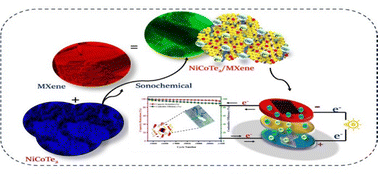
Transition metal chalcogenides are promising electrode materials for electrochemical supercapacitors; however, their performance is often hindered by restacking issues during energy storage processes. Alternatively, integrating MXene nanosheets with chalcogens such as tellurides can effectively mitigate these issues. Thus, this study explores the potential of NiCoTe2 (bimetallic tellurides) for energy storage applications, highlighting that the synergistic interaction existing between MXene (Ti3C2Tx) and NiCoTe2 significantly enhances their electrochemical performance. Initially, NiCoTe2 nanorod arrays were synthesized via a hydrothermal method, and the NiCoTe2/MXene composite was subsequently developed using a sonochemical approach. Subsequently, electrochemical characterization of the composite, employing a graphite sheet (GS) as the working electrode, demonstrated a high specific capacity of 582 mAh g−1 at a current density of 1 A g−1 within the negative potential range. Moreover, the asymmetric supercapacitor device, NiCoTe2/MXene||AC, delivered a specific capacity of 298 mAh g−1 at 1 A g−1, along with exceptional cyclic stability (94% capacity retention after 10 000 cycles), an energy density of 83.38 Wh kg−1, and a power density of 577.24 W kg−1. Thus, the results underscore the potential of this composite for application in practical energy storage systems.
 Please wait while we load your content...


