


 PLATFORM UPDATE:

Rational experimental design and computational insights into novel heteroleptic mixed-ligand Ru(ii) complexes possessing derivatized bipyridines and phendione for anti-cancer activities

Abstract
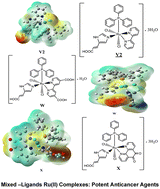
Several synthesized ruthenium(II) complexes, which are used as metallo-drug agents for cancer treatment, have fallen short of meeting expectations. In our continued efforts to search for potential anticancer drug agents for specific biological targets through rational design, this paper reports a facile, one-pot synthesis procedure, along with the photophysical and electro-redox properties, of three newly designed mixed-ligand ruthenium(II) complexes. These complexes contain triphenylphosphine (PPh3), 4-imidazole acrylic acid (mza), and either functionalized or unfunctionalized polypyridines, specifically 2,2′-bipyridine-4.4′-dicarboxylic acid (Hbpy), 1,10-phenanthroline-5,6-dione (ptd), and 2,2′-bipyridine (bpy). The complexes are formulated as follows: V2 = [RuCl2(PPh3)bpy(mza)·3H2O], W = [RuCl2(PPh3)Hbpy(mza)·H2O] and X = [RuCl2(PPh3)ptd(mza)·3H2O]. The complexes were characterized by elemental analysis, Fourier-Transform infrared spectroscopy (FT-IR), ultraviolet–visible spectroscopy (UV-vis), photoluminescence (PL), 1H, 13C, 31P nuclear magnetic resonance (NMR) spectroscopy, and mass spectrometry (MS). The UV-vis absorption spectra, showed a broad and intense metal-to-ligand charge transfer (MLCT) band with a strong emission intensity ratio near infra-red. The maximum absorbance wavelengths λmax were observed at 415–530 nm (ε ≈ 1.030 × 10³ M−1 cm−1) and λem 730–640 nm respectively. The structure–activity relationships relate to a set of voltage-current data, with ligand-based electrochemical redox processes occuring at the Ru(III/II) redox range of +1.15 and –0.82 V. Density functional theory (DFT), molecular docking, and pharmacokinetic calculations confirm that complexes V2, W and X exhibit superior and strong binding interactions and biological inhibition trafficking involving ERα +, WT EGFR, and ALK receptors compared to standard drugs such as Crizotinib, Doxorubicin, Gemcitabine and Lorlatinib. However, the high molecular weights and poor lypophilicity of the complexes hinder their ability to cross the blood–brain barrier (BBB), thus limiting their utility for central nervous system (CNS) targets. This study primarily focuses on the synthesis, characterization, and theoretical evaluation of complexes V2, W and X for their potential anticancer properties, which is useful in the discovery of new materials for drug design. No complementary in-vitro wet laboratory tests for anticancer or other biological methods of analysis were conducted, as they were outside the scope of the present study.
 Please wait while we load your content...


