


 PLATFORM UPDATE:


Morpho-mechanical tuning of porous PLA–PCL–PEG hybrid scaffolds with inorganic fillers for bone repair

Abstract
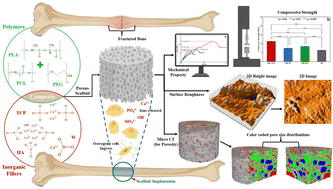
The rational design of polymer-ceramic composite scaffolds remains central to bone tissue engineering, where mechanical robustness must be reconciled with bioactive functionality. In this study, porous scaffolds were engineered from a ternary polymer matrix of poly(lactic acid) (PLA), poly(ε-caprolactone) (PCL), and poly(ethylene glycol) (PEG), reinforced with β-tricalcium phosphate (β-TCP), or wollastonite (CaSiO3), or hydroxyapatite (HA). A gel-foam casting cum rapid heating route enabled hierarchical porosity, yielding scaffolds with interconnected macropores (65–765 µm) and nanoscale roughness modulated by filler type. Comprehensive mechanical testing revealed distinct filler-dependent reinforcement: β-TCP provided the most balanced profile of compressive (11.4 MPa), tensile (11.9 MPa), and flexural strength (17.6 MPa), wollastonite enhanced toughness and surface roughness (Sa ≈ 41 nm), while HA imparted superior stiffness (modulus 0.041 GPa) and biomimetic mineral character. Micro-CT and SEM confirmed high open porosity (48%) with interconnected pore networks conducive to vascular infiltration, while AFM mapping demonstrated nanoscale topographies within the osteogenic roughness window. These hierarchical architectures not only preserved load bearing capacity within the range of cancellous bone but also provided bioactive cues for osteoblast adhesion and differentiation. Collectively, the results underscore the capacity of polymer-ceramic hybrid chemistry to tune mechanical, morphological, and interfacial properties synergistically, offering a design platform for application specific scaffolds in regenerative orthopedics.
 Please wait while we load your content...


