


Structural evolution of alkali-metal-ion intercalated layered niobates under thermal treatment
 *b
*b
Abstract
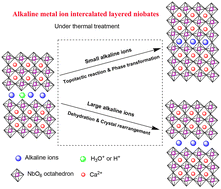
Dion–Jacobson layered perovskites have a low out-of-plane thermal conductivity and high crystallinity, endowing them with potential for broad applications in the field of high-temperature insulation. However, ion exchange ability could cause a dramatic change in the high temperature performance when the layered perovskites involve relevant solution processes, in particular the thermal stability. Therefore, it is essential to understand the influence of the ion exchange on the high temperature performance. In this study, we prepared layered niobates intercalated with different alkali-metal ions via ion exchange and studied their thermal stability and thermal conductivity. We found that the thermal stability increases with the increase in the interlayer ion size, and the interlayer spacing is the main factor affecting the thermal stability. In particular, the K+-ion intercalated niobate only underwent a slight phase transition at 800 °C and maintained the layered structure at 1200 °C, demonstrating high thermal stability. Additionally, the thermal conductivity of the layered niobates decreases as the size of interlayer ions increases. Our work shows that appropriate control of the interlayer spacing is key to obtaining high performance layered niobates for high temperature thermal insulation.
 Please wait while we load your content...


