


 PLATFORM UPDATE:


Diethylenetriamine-functionalized magnetic chitosan/magnetic polyglycidyl methacrylate for Pb(ii), Cd(ii), and Cu(ii) recovery from water

Abstract
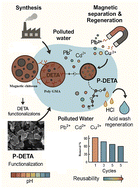
This study introduces a hybrid sorbent, diethylenetriamine-functionalized magnetic chitosan/magnetic poly(glycidyl methacrylate) (P-DETA), designed for the recovery of Pb(II), Cd(II), and Cu(II) from contaminated water systems. The sorbent was synthesized through a multi-step process involving the polymerization of glycidyl methacrylate with magnetic chitosan and subsequent functionalization with diethylenetriamine (DETA), endowing it with enhanced chelating properties and magnetic separability. Characterization techniques, including FTIR, SEM-EDX, TEM, BET surface area analysis, TGA, and VSM, confirmed the successful integration of Fe3O4 nanoparticles (average size: 9.55 nm) within the polymeric matrix, yielding a BET surface area of 11.0 m2 g−1 and superparamagnetic behavior (saturation magnetization: ≈20 emu g−1). The adsorption kinetics adhered to a pseudo-second-order model (R2 > 0.999), and intraparticle diffusion analysis indicated a three-stage mechanism. Langmuir isotherm modeling indicated monolayer adsorption with maximum capacities of 70.42 mg g−1 (Pb), 59.17 mg g−1 (Cd), and 55.25 mg g−1 (Cu), outperforming conventional adsorbents, such as activated carbon and biochar. Thermodynamic studies confirmed spontaneous, exothermic processes, with Cu(II) exhibiting the strongest affinity due to its smaller hydrated radius (2.95 Å) and higher electronegativity. The sorbent maintained >75% efficiency over five regeneration cycles using 0.5 M HCl, with Cu(II) showing the highest stability (93.48% desorption). Real-world applicability was validated in complex matrices: tap water (qe: 7.43, 6.27, and 5.41 mg g−1 for Pb, Cd, and Cu, respectively) and industrial wastewater (qe: 6.31, 5.64, and 4.12 mg g−1, respectively), despite competitive ion interference. A detailed cost analysis ($130–150 $ per kg) underscored its scalability, with glycidyl methacrylate as the major cost driver. The synergistic combination of high selectivity, magnetic recovery, and reusability of P-DETA positions it as a sustainable solution for heavy-metal remediation in diverse aqueous environments.
 Please wait while we load your content...


