


Unveiling reaction mechanisms of copper-based catalysts for peroxymonosulfate activation in Fenton-like reactions for sustainable water decontamination

Abstract
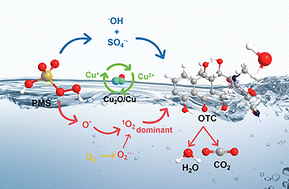
Peroxymonosulfate (PMS) based Fenton-like reactions have attracted great interest for the remediation of wastewater, but the temperature regulation for maintaining the effectiveness of the catalysts remains unclear. Here, copper-based nanomaterials were synthesized by regulating the copper valence at different calcination temperatures and they were also used as Fenton-like catalysts to activate PMS for the degradation of oxytetracycline (OTC). The results showed that the Cu-450 catalyst exhibited the best catalytic performance in activating PMS to degrade OTC, with a removal rate of over 95% within 16 min. Various characterization techniques revealed that the crystal structure and surface properties of the materials were significantly affected by the calcination temperature. Quenching experiments and electron paramagnetic resonance results indicated that the main reactive oxygen species in the system were singlet oxygen and superoxide radicals. The Cu-450-PMS system showed strong tolerance to the changing pH range (4–10) and water environments and this reaction system also exhibited high degradation efficiency towards OTC, tetracycline, methyl orange, phenol, and ciprofloxacin. The OTC degradation followed pseudo-first-order kinetics, and Cu-450 has a rate constant of 0.193 min−1, which was 3.06 and 2.57 times higher than those of Cu-250 and Cu-650. Analysis using a toxicity estimation software tool showed that the toxicity of OTC and its degradation intermediates was significantly reduced. This study provides a highly effective and feasible method for effectively removing OTC from polluted water.
 Please wait while we load your content...


