


 PLATFORM UPDATE:


Structural study and physico-chemical characterization of the novel triple tungstate Na4Cu(WO4)3 with alluaudite-like structure
 *ab
*ab
Abstract
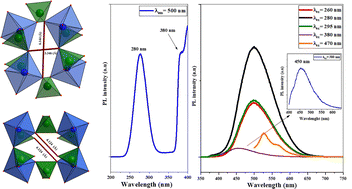
A novel tetrasodium copper tritungstate compound was successfully synthesized via the solid-state method. Rietveld refinement of the X-ray diffraction (XRD) pattern confirmed the existence of a pure Na4Cu(WO4)3 phase. The alluaudite structure of Na4Cu(WO4)3 features [(Cu,Na)2O10] octahedral dimers and [WO4] tetrahedra sharing corners, creating a three-dimensional framework that contains hexagonal-shaped channels along the c-axis, accommodating Na+ cations. Single-crystal X-ray diffraction measurements indicated that the compound crystallizes in a monoclinic structure with dimensions a = 12.417(3) Å, b = 13.903(4) Å, c = 7.153(5) Å, and β = 111.541(6)°. Charge-distribution calculations were utilized to confirm the structural model. Raman spectroscopy results exhibited an intense band at 940 cm−1, attributed to symmetric W–O stretching in [WO4] groups. The alluaudite compound was analyzed using UV-visible, photoluminescence (PL), and X-ray photoelectron spectroscopy (XPS). Absorption characteristics were measured in the range of 200–900 nm. Na4Cu(WO4)3 exhibits absorption features in the 200–400 nm range, attributed to ligand-to-metal charge-transfer (LMCT) transitions, with an estimated optical band gap of 2.84 eV. Photoluminescence measurements showed an excitation peak at 280 nm, corresponding to an oxygen-to-metal (O2− → W6+) charge-transfer band (CTB). The emission spectrum revealed a broad band centered at 500 nm, ascribed to the radiative recombination associated with the 2Eg → 2T2g transition of Cu2+ ions in octahedral coordination. The XPS was further employed to investigate the surface composition and the electronic states of the constituent elements.
 Please wait while we load your content...


