


 PLATFORM UPDATE:


Synthesis and study of pyridine-based nitrogen-rich porous organic polytriazine for the highly efficient capture of SO2
 *a
Kuanyu
Yuan
*a
and
*a
Kuanyu
Yuan
*a
and
Abstract
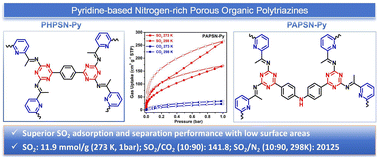
SO2, owing to its serious health and environmental risks, has driven the development of highly efficient materials for its capture and sequestration. In this work, two novel, pyridine-based, electron-rich, porous organic poly(Schiff-base) networks—PHPSN-Py and PAPSN-Py—were constructed through catalyst-free Schiff-base condensation reactions. Their chemical and porous structures were characterized in detail. The influence of their significantly different spatial topologies on their structures and properties was investigated. These two porous materials, despite their relatively low BET surface areas of 8 and 22 m2 g−1, demonstrated excellent SO2 capture and separation performance, with adsorption uptakes up to 11.9 mmol g−1 (273 K, 1 bar), 7.6 mmol g−1 (298 K, 1 bar) and 1.62 mmol g−1 (298 K, 0.01bar), owing to their nitrogen-rich skeletons that are beneficial for deep sulfurization. This very competitive performance exceeded those of many previously reported nanoporous materials. Meanwhile, the IAST selectivities for SO2/CO2 (10/90, v/v) could reach 141.8 and 89.4 at 273 and 298 K and 1 bar. This study represents a novel pyridine-based, porous organic material and confirms its intrinsic potential for the highly efficient removal of SO2. This could provide valuable insights into developing new porous desulfurization materials.
 Please wait while we load your content...


