


 PLATFORM UPDATE:

Novel formyl pyrazole derivatives as potential antimicrobial and anticancer agents: synthesis, structural characterization insights, and diverse in vitro biological evaluations

Abstract
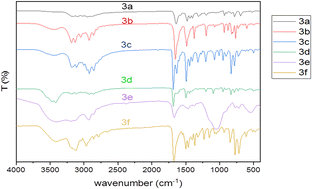
Novel 1H-pyrazole-4-carbaldehydes (3a–f) and 1-(4-vinylbenzyl)-3-aryl-1H-pyrazole-4-carbaldehydes (4a–f) were effectively synthesized in good yields under mild and straightforward reaction conditions. The synthesized compounds were thoroughly characterized using 1H-NMR, 13C-NMR, and FT-IR spectroscopic techniques. All of the target compounds were evaluated for their in vitro antimicrobial activity against a model of yeast like Candida albicans, Gram-positive bacteria like Staphylococcus aureus and Gram-negative bacteria like Escherichia coli, Salmonella typhimurium, and Klebsiella pneumonia. The results obtained show that 3-(thiophene-2-yl)-1H-pyrazole-4-carbaldehyde (3f) and 3-(thiophene-2-yl)-1-(4-vinylbenzyl)pyrazole-4-carbaldehyde (4f) show the most promising antibacterial activity, compared to other compounds. The anticancer effects of synthesized compounds were evaluated in vitro using the HeLa cell line. Compound 4a with a phenyl group showed the greatest potency for reducing cell viability, demonstrating the maximum cytotoxicity against HeLa cells, while compounds 4b, 4c, and 4d exhibited moderate cytotoxicity, resulting in cell viability of approximately 50%, and diminished cell viability to differing extents, although less significantly compared to compound 4a. The cytotoxicity test illustrated a potential selectivity in their effects on cells. These findings suggest that modified synthesized compounds are promising candidates for future and promising anticancer therapeutics.
 Please wait while we load your content...


