


 PLATFORM UPDATE:


Unveiling the optical and piezoelectric properties of organic–inorganic hybrid perovskites FAPbX3 (X = Cl, Br, I): a DFT study
Abstract
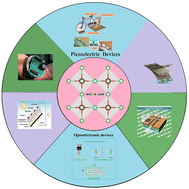
This work discloses an investigation of the optical and piezoelectric properties of FAPbX3 (X = Cl, Br, I) by employing density functional theory (DFT). Our results reveal that all the compounds are semiconductor in nature. The material's thermodynamical stability was validated by using formation energy calculation, where FAPbCl3 was found to be the most stable among the investigated compounds. Each substitution of the X-site atom leads to an increase in volume with a decrease in band gap due to the increase in the atomic radius of the halogen atom. The optical properties such as dielectric functions, refractive index, extinction coefficient, reflectivity and absorption coefficient were explored, showing promising properties for an optoelectronic device. Each compound's mechanical stability is validated using Born criteria. Among the studied compounds, FAPbCl3 stands out as the most efficient for piezoelectric application with a maximum response of e33 = −1.55 C m−2. Overall, the investigated compounds are feasible candidates for optoelectronic and piezoelectric device fabrication due to their prospective optical and piezoelectric properties.
 Please wait while we load your content...


