


Chemically anchored metal–hydrogel bilayers for ultrasoft and metallic biointerfaces
 †ab
Jun Yong
Lee,
†ab
Jeeyoung
Kim,
ab
Hyunjin
Lee,
ab
Seonghae
Park,
ab
Dae-Hyeong
Kim
*ab
†ab
Jun Yong
Lee,
†ab
Jeeyoung
Kim,
ab
Hyunjin
Lee,
ab
Seonghae
Park,
ab
Dae-Hyeong
Kim
*ab
Abstract
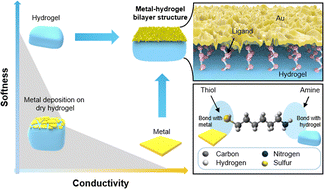
Metals are essential components of bioelectronic systems, such as contact electrodes, interconnects, and sensors. However, their inherent rigidity poses major challenges for integration in soft bioelectronics. In particular, the mechanical mismatch between metals and biological tissues can cause reduced signal fidelity and unwanted tissue damage. To address these issues, various geometrical engineering approaches have been explored to increase the deformability of metals. For example, strain-relief layers have been investigated; however, physically laminated structures often fail to adequately dissipate strain under deformation. Here, we present a chemically conjugated, monolithic metal–hydrogel bilayer, imparting high deformability to metals with minimal compromise in electrical conductivity. The formation of chemically anchored ligand interactions between the metal and hydrogel induces uniform wrinkles in the metal layer, effectively mitigating stress concentration. Consequently, the monolithic bilayer exhibits ultrasoft mechanical properties and metallic electrical performance, including high electrical conductivity, low impedance, tissue adhesion, and stretchability. The chemical anchoring process is spatially programmable, making it suitable for the fabrication of arrays of soft bioelectronic devices. We validated the performance and functionality of this platform in cardiac applications, demonstrating its efficacy in both electrophysiological recording and electrical stimulation.
- This article is part of the themed collections: 2026 Chinese New Year and Lunar New Year Collection and Celebrating 10 Years of Nanoscale Horizons: 10th Anniversary Collection
 Please wait while we load your content...


