Lipid nanoparticles for engineering next generation CAR T cell immunotherapy

Abstract

Lipid nanoparticles are a burgeoning technology which has vast potential to improve chimeric antigen receptor (CAR) T cell immunotherapy. This focused review provides an overview of CAR T cell therapy – highlighting its promises, limitations, and challenges – and describes ways in which lipid nanoparticles (LNPs) can be rationally designed to circumvent some of the challenges. Of particular note are antigen presenting cell-mimetic LNPs, which have the potential to streamline the CAR T cell production process by activating T cells and delivering the CAR transgene in a single step. Although the current clinical standard is ex vivo CAR T cell production, in vivo CAR T cell production represents a potentially transformative alternative. Recent innovations in each production method are described, with a particular emphasis on ways in which LNPs may enable in vivo CAR T cell production. The review concludes with a discussion of safety, immunogenicity, scalability, manufacturing, and regulatory factors which will be essential as LNP-based CAR T cell immunotherapies move toward clinical translation.
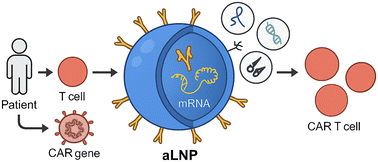
Graphical abstract: Lipid nanoparticles for engineering next generation CAR T cell immunotherapy

Transparent peer review

To support increased transparency, we offer authors the option to publish the peer review history alongside their article.

View this article’s peer review history

Article information

Article type
Focus
Submitted
22 Jun 2025
Accepted
02 Oct 2025
First published
20 Oct 2025
This article is Open Access
Creative Commons BY-NC license

Nanoscale Horiz., 2026, Advance Article

Lipid nanoparticles for engineering next generation CAR T cell immunotherapy

M. J. Y. Ang, A. E. Metzloff, A. S. Thatte and M. J. Mitchell, Nanoscale Horiz., 2026, Advance Article , DOI: 10.1039/D5NH00432B

This article is licensed under a Creative Commons Attribution-NonCommercial 3.0 Unported Licence. You can use material from this article in other publications, without requesting further permission from the RSC, provided that the correct acknowledgement is given and it is not used for commercial purposes.

To request permission to reproduce material from this article in a commercial publication, please go to the Copyright Clearance Center request page.

If you are an author contributing to an RSC publication, you do not need to request permission provided correct acknowledgement is given.

If you are the author of this article, you do not need to request permission to reproduce figures and diagrams provided correct acknowledgement is given. If you want to reproduce the whole article in a third-party commercial publication (excluding your thesis/dissertation for which permission is not required) please go to the Copyright Clearance Center request page.

Read more about how to correctly acknowledge RSC content.

Social activity

Spotlight

Advertisements