


 PLATFORM UPDATE:


Green synthesis of V2C MXene quantum dots with tunable nonlinear absorption for optical limiting applications

Abstract
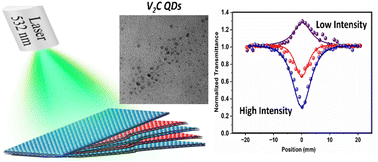
Vanadium carbide MXene quantum dots (V2C QDs) have emerged as promising nanoscale materials with tunable surface chemistry and pronounced quantum confinement effects. Herein, we report a green, HF-free synthesis of highly fluorescent V2C QDs directly from the MAX phase via pulsed laser ablation in a binary solvent system. The synthesized quantum dots exhibited a production yield of 27% and a narrow size distribution, with an average diameter of 2.5 nm. Furthermore, they exhibit intense and stable photoluminescence with a quantum yield of 11.5%. Their optically tunable emission, combined with excellent optical stability, positions them as strong candidates for high-resolution bioimaging and biosensing applications. We investigated their nonlinear optical response using an open-aperture Z-scan technique at 532 nm, which revealed a dual behavior, namely saturable absorption at low excitation intensities and strong reverse saturable absorption at higher intensities. These materials also show a good optical limiting performance, characterized by a low onset threshold. The unique coexistence of stable fluorescence and robust nonlinear optical properties makes V2C QDs an attractive option for advancements in laser protection, optoelectronics, and multifunctional biomedical photonics. These results provide a sustainable approach to synthesizing high-quality V2C QDs and highlight their potential in bridging nanophotonics and biomedicine through versatile optical functionalities.
 Please wait while we load your content...


