


 PLATFORM UPDATE:


Architecturally robust design of ethylenediamine-assisted polyaniline/MXene nanohybrids for symmetric pouch-cell supercapacitors
 b
and
Chandra Sekhar
Rout
*ab
b
and
Chandra Sekhar
Rout
*ab
Abstract
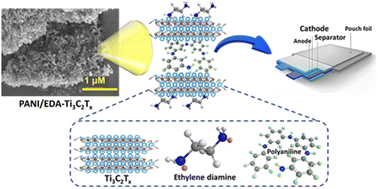
Two-dimensional multi-layered MXenes have garnered significant research attention as an effective electrode material for supercapacitor fabrication, attributed to its exceptional mechanical and electrochemical properties. Nonetheless, MXenes face challenges like restacking issues, relatively lower electrochemical performance, and reduced electrical conductivity due to residual oxygen functional groups. A viable strategy to address these challenges involves intercalation and surface modification with ethylene diamine (EDA) molecules. In this study, we employed a two-step approach, beginning with a hydrothermal method to synthesize EDA-MXene, followed by in situ polymerization with aniline to produce a PANI/EDA-MXene hybrid. The PANI nanostructures that grow in situ on the surface-modified EDA-MXene nanosheets help mitigate the volume changes typically observed in PANI during charging/discharging cycles and facilitate faster charge transport across the surface. The surface-modified MXene nanosheets with EDA molecules serve as a foundational framework for the homogeneous growth of PANI nanorods, which enhance electrode–electrolyte interactions. Dunn analysis revealed a significant capacitive contribution thereby improving the overall charge storage capacity. At an optimized concentration of EDA and PANI, the PANI(II)/MXene-EDA(II) composite was utilized for the fabrication of symmetric pouch-cell supercapacitors. The device achieved a maximum areal capacitance of 668 mF cm−2 at 0.5 mA cm−2, with 95% capacitance retention over 8000 consecutive charge–discharge cycles. Furthermore, it delivered a maximum energy density of 59.3 Wh cm−2 and a power density of 778.3 W cm−2, indicating its potential for real-time applications. The synergistic effects of the EDA-intercalated MXene sheets, which prevent restacking issues, and the pseudocapacitive behaviour of the conducting polymer resulted in enhanced charge storage capacity.
- This article is part of the themed collections: 2026 Chinese New Year and Lunar New Year Collection and Popular Advances
 Please wait while we load your content...


