


 PLATFORM UPDATE:


Nitrogen-doped Cu4O3 thin films as high-performance counter electrodes for quantum dot-sensitized solar cells

Abstract
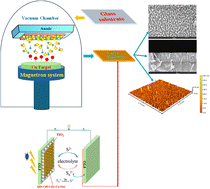
P-type metal oxide semiconductors are critical components in the development of next-generation optoelectronic and photovoltaic devices. While n-type materials such as SnO2, ZnO, and ITO are well-established, the lack of stable, high-performance p-type transparent oxides with suitable bandgaps remains a key limitation. Among copper oxides, Cu4O3—a mixed-valence oxide—offers promising electronic and optical tunability, yet has been underexplored for device integration. In this work, nitrogen-doped Cu4O3 thin films were synthesized via DC magnetron sputtering under an (Ar + 10% O2)/N2 atmosphere. The incorporation of nitrogen effectively modulated the electronic structure, enhanced chemical stability, and improved electrical transport properties. The optimal film, denoted as Cu4O3-30 (30% N2), exhibited a direct optical bandgap of 2.18 eV, resistivity of 4.19 Ω cm, hole concentration of 3.33 × 1017 cm−3, and hole mobility of 4.48 cm2 V−1 s−1. When implemented as a counter electrode in TiO2/CdS/CdSe:Cu/ZnS quantum dot-sensitized solar cells (QDSSCs), the device achieved a power conversion efficiency of 7.29%, exceeding the performance of its Cu2S-based counterparts. These results highlight the potential of N-doped Cu4O3 as a scalable, chemically stable, and electrically efficient p-type oxide for emerging optoelectronic and photovoltaic technologies.
 Please wait while we load your content...


