


 PLATFORM UPDATE:

Heavy boron doping effects on biaxially tensile strained germanium (>1.5%) investigated via structural characterization, effective lifetime assessment and atomistic modeling

Abstract
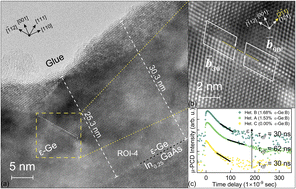
Highly tensile strained germanium (ε-Ge) represents an essential material system for emerging electronic and photonics applications. Moreover, adjusting the doping levels to moderate or high concentrations can effectively tailor the properties of ε-Ge for specific applications. This article combines experimental characterization with a theoretical framework to examine the effects of heavy elemental boron (B) doping on pseudomorphic sub-50 nm ε-Ge. High resolution X-ray diffractometry is used to validate tensile strain levels of 1.53% and 1.68% in Ge epilayers, surpassing the indirect-to-direct band gap crossover point at ∼1.5% biaxial tensile strain. Cross-sectional transmission electron microscopy revealed visual evidence of stacking faults and surface roughening in 1.68% ε-Ge, although a coherent and abrupt Ge/III–V heterointerface is observed, devoid of interfacial misfit dislocations. Effective lifetime measurements demonstrated approximately twofold enhancement in 1.53% B-doped ε-Ge (NB ∼7 × 1019 cm−3) compared to its unstrained B-doped counterpart, while no such improvement was observed in 1.68% B-doped ε-Ge. This lack of enhancement is attributed to the presence of stacking faults and surface roughness within the ε-Ge epilayer. Through density functional theory calculations, we independently demonstrate that substitutional B atoms induce local deformation of Ge–Ge bonds in both unstrained Ge and ε-Ge epilayers, resulting in an additive tensile strain. This phenomenon could potentially lead to dynamic reduction and overcoming of the critical layer thickness for the system, facilitating the nucleation and subsequent glide of 90° leading Shockley partial dislocations, thereby generating stacking faults. In essence, these findings establish an upper limit on the B-doping concentration that can be achieved in highly ε-Ge epilayers, and collectively, offer valuable insights into the significance of heavy doping in Ge-based heterostructures. As such, this study delineates a fundamental constraint for integrating heavily doped ε-Ge in high-performance optoelectronic systems, necessitating precise strain-doping co-optimization to avoid performance degradation.
 Please wait while we load your content...


