


 PLATFORM UPDATE:

Improving oral bioavailability of acalabrutinib using polymer–lipid hybrid nanoparticles: design, optimization, and in vivo pharmacokinetic evaluation
 *a
*a
Abstract
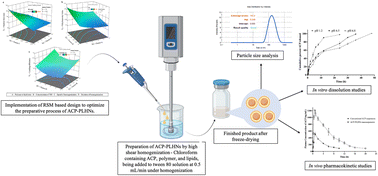
Acalabrutinib (ACP) is one of the first-in-line treatments for hematological malignancies with minimal adverse drug reactions. However, ACP has low and variable bioavailability due to pH-dependent solubility, CYP3A4 metabolism, and P-gp efflux. This research aims to modify the dissolution behavior of ACP and improve its oral bioavailability through formulation of polymer–lipid hybrid nanoparticles (PLHNs). ACP-loaded PLHNs (ACP-PLHNs) were prepared by the emulsification–solvent evaporation method using a high shear homogenizer and optimized using a spherical and rotatable circumscribed central composite design. The optimized ACP-PLHNs exhibited a spherical morphology with an average particle size of 150.2 ± 10.7 nm, a PDI of 0.284 ± 0.06, and sufficient drug loading (20.79 ± 3.61%). In vitro dissolution studies showed that over 50% of ACP was released from the PLHNs at pH 1.2 within 4 h, reaching nearly 100% release by 24 h. While, at pH ≥ 4.5, 43–55% of ACP was released by 8 h, with sustained release observed for up to 2 days. In vivo hemolysis assay indicated that ACP-PLHNs were safe for oral administration. Storage stability studies over 6 months demonstrated optimal physico-chemical stability when stored at 5 °C. In vivo oral pharmacokinetic studies revealed that ACP-PLHN nanosuspension resulted in a 3.41-fold increase in bioavailability (p < 0.001) compared to the conventional ACP suspension, along with a >2-fold increase in drug distribution towards the spleen (p < 0.001), a critical target site for B-cell accumulation and proliferation.
 Please wait while we load your content...


