


 PLATFORM UPDATE:


Fibrin/MoS2-nanosheet conductive hydrogels with programmed time scales and pathways for bioresorption
 a
Deisy
Fernandes,
†a
Mark
Daley,
a
Anubhav
Tripathi,
ac
Jacob K.
Rosenstein,
ac
Robert H.
Hurt
*ac
a
Deisy
Fernandes,
†a
Mark
Daley,
a
Anubhav
Tripathi,
ac
Jacob K.
Rosenstein,
ac
Robert H.
Hurt
*ac
Abstract
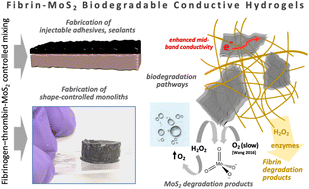
Electrically conductive hydrogels are of interest as scaffolds for tissue engineering applications involving the growth, implantation, or attachment of electrically active cells. Such hydrogels should exhibit soft mechanics, tunable conductivity to match native tissue, biocompatibility, and biodegradability into non-toxic, clearable species. Common conductors based on metals or polymers can be challenged by insufficient biocompatibility or biodegradability. A potential new alternative is the use of composites containing 1T-phase MoS2 nanosheet fillers, which have a metallic nature and undergo oxidative biodegradation over clinically useful time scales. Chemically exfoliated MoS2 is introduced into assembly protocols for fibrin hydrogels and the composites characterized by electrochemical impedance spectroscopy, which reveals a 400% increase in conductivity in the physiologically important mid-band region of 103–104 hertz. In vitro studies on fibrin/MoS2 composite hydrogels show complex multipath biodegradation behaviors. Matrix metalloprotease action degrades fibrin to soluble protein, without attacking the nanosheets. The nanosheets degrade separately by H2O2 oxidation to soluble molybdate in a self-limiting reaction inhibited by the catalysis of peroxide decomposition by the molybdate product. Genipin cross-linking is demonstrated as a method to stabilize the fibrin network, control the overall hydrogel monolith lifetime, and control the biodegradation pathway to avoid nanosheet release by early loss of the fibrin network. The composite degradation products were found to be non-cytotoxic to primary cardiac fibroblasts by the MTT assay. Overall, 1T-phase MoS2 nanosheets offer an attractive alternative to currently available inorganic or polymeric additives for creating conductive, bioresorbable, and biocompatible hydrogels.
 Please wait while we load your content...


