Issue 6, 2025

Structure–performance relationships of mechanochemically synthesized piezoelectric catalysts BaTiO3, NaNbO3 and BiFeO3

Abstract

Piezoelectric catalysts were synthesized mechanochemically by converting BaCO3 and TiO2 to BaTiO3, Na2CO3 and Nb2O5 to NaNbO3 and Bi2O3 and Fe2O3 to BiFeO3. The catalytic reactivity of BaTiO3, NaNbO3 and BiFeO3 was tested using a mechanocatalytic arylation reaction involving 4-nitrobenzenediazonium tetrafluoroborate. The observed activity in the arylation reaction showed a dependence on the abundance of piezoelectrically active anisotropic phases as measured by the pre-edge intensity in XANES spectra of BaTiO3 and NaNbO3 and distribution of crystalline phases as measured by XRD for BiFeO3. A kinetic analysis showed that the reaction over BaTiO3 was limited by the amount of diazonium salt remaining in the reaction vessel, while the reaction over NaNbO3 and BiFeO3 was limited by the generation of electron hole pairs within the piezoelectric structure. This work shows that mechanochemically produced piezocatalysts have superior structural characteristics such as greater relative abundance of anisotropic phases, higher surface areas and smaller particle sizes that led the mechanochemically produced catalysts to outperform piezoelectric commercial counterparts when tested under the same arylation milling conditions.
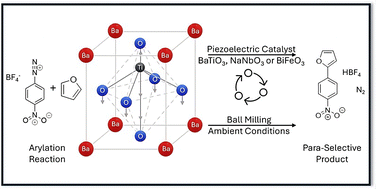
Graphical abstract: Structure–performance relationships of mechanochemically synthesized piezoelectric catalysts BaTiO3, NaNbO3 and BiFeO3

Supplementary files

Article information

Article type
Paper
Submitted
06 May 2025
Accepted
28 Aug 2025
First published
28 Aug 2025
This article is Open Access
Creative Commons BY-NC license

RSC Mechanochem., 2025,2, 864-878

Structure–performance relationships of mechanochemically synthesized piezoelectric catalysts BaTiO3, NaNbO3 and BiFeO3

E. V. Phillips, V. S. Nguyen, M. Hatzell and C. Sievers, RSC Mechanochem., 2025, 2, 864 DOI: 10.1039/D5MR00062A

This article is licensed under a Creative Commons Attribution-NonCommercial 3.0 Unported Licence. You can use material from this article in other publications, without requesting further permission from the RSC, provided that the correct acknowledgement is given and it is not used for commercial purposes.

To request permission to reproduce material from this article in a commercial publication, please go to the Copyright Clearance Center request page.

If you are an author contributing to an RSC publication, you do not need to request permission provided correct acknowledgement is given.

If you are the author of this article, you do not need to request permission to reproduce figures and diagrams provided correct acknowledgement is given. If you want to reproduce the whole article in a third-party commercial publication (excluding your thesis/dissertation for which permission is not required) please go to the Copyright Clearance Center request page.

Read more about how to correctly acknowledge RSC content.

Social activity

Spotlight

Advertisements