


 PLATFORM UPDATE:


Development of a nitric oxide-releasing cephalexin-based hybrid compound for enhanced antimicrobial efficacy and biofilm disruption
 a
Myddelton C.
Parker,
a
Anastasia
Marx,
a
Hitesh
Handa
ab
and
Elizabeth J.
Brisbois
*a
a
Myddelton C.
Parker,
a
Anastasia
Marx,
a
Hitesh
Handa
ab
and
Elizabeth J.
Brisbois
*a
Abstract
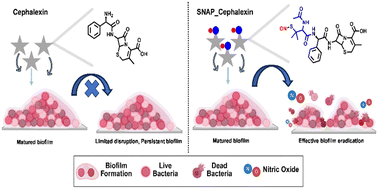
Biofilm formation on medical devices and the rise of antibiotic resistance have undermined conventional antibiotics such as cephalexin (CEX), which is effective against Gram-positive infections but has limited activity against Gram-negative pathogens and biofilms. To overcome these limitations, we developed a hybrid nitric oxide (NO)-releasing conjugate (SNAP_CEX) by covalently attaching the NO donor S-nitroso-N-acetylpenicillamine (SNAP) to CEX. SNAP_CEX exhibited a sustained NO release profile over 30 days, indicating enhanced stability compared to SNAP's rapid degradation, even though the Griess assay showed NO release from SNAP over 30 days. The hybrid maintained strong antibacterial activity against Staphylococcus aureus (S. aureus; MIC50 = 7 μM vs. 2.5 μM for CEX) and dramatically improved efficacy against Pseudomonas aeruginosa (P. aeruginosa; MIC50 = 3 mM vs. 16 mM for CEX). SNAP_CEX also significantly disrupted established biofilms, reducing S. aureus biofilm biomass by ∼75% (vs. ∼33% by CEX) and viable cells by ∼99%, and achieving ∼67% biomass reduction and 77% killing in P. aeruginosa biofilms (vs. ∼25% and 18% by CEX). These effects demonstrate that SNAP_CEX combines NO's biofilm-disruptive action with antibiotic therapy to combat biofilm-associated resistant infections, while remaining cytocompatible at therapeutic concentrations.
 Please wait while we load your content...


