


 PLATFORM UPDATE:

Design and synthesis of thermally robust pyrazine–tetrazole hybrids as high-nitrogen energetic materials

Abstract
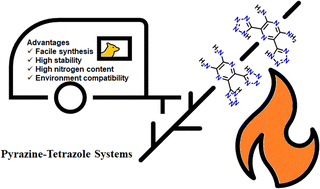
The development of advanced heat-resistant energetic materials for extreme environments demands molecular frameworks that combine high decomposition temperatures, strong detonation performance, and synthetic accessibility. In this study, nitrogen-rich pyrazine–tetrazole hybrids designed to achieve this balance are introduced. Pyrazine cores, functionalized with amine-tetrazole units, promote dense molecular packing owing to hydrogen-bond networks, resulting in enhanced thermal stability. Thermal analysis discovered decomposition onset temperatures of 305 °C (compound 2) and 320 °C (compound 5), values surpassing TNT (295 °C) and approaching HNS benchmarks (318 °C). Calculated detonation velocities (7383 and 7278 m s−1) and detonation pressures (18.8 and 18.2 GPa) highlight their energetic efficiency while maintaining reduced sensitivity compared to conventional polynitro systems. Importantly, the synthetic approach employs facile precursor transformations, underscoring scalability. Together, these findings demonstrate a rational pathway toward nitrogen-rich heterocycles that function as structurally robust, thermally stable high-energy-density materials (HEDMs). This work provides new insights into molecular innovation and expands the design landscape for insensitive explosives, extending the operational limits of energetic systems in aerospace, defense, and industrial applications.
 Please wait while we load your content...


