


 PLATFORM UPDATE:


The impact of growth method on the structural and electronic properties of Nb:Bi2WO6 thin films for high-power pn junction applications

Abstract
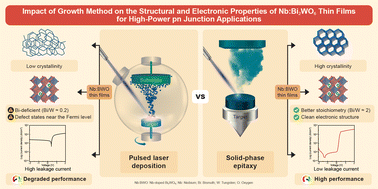
Development of high-breakdown voltage power devices requires designing suitable p-type wide-bandgap oxide semiconductors. We investigated the growth of Nb-doped Bi2WO6 (Nb:BWO) thin films, which are promising candidates for p-type wide-bandgap oxide semiconductors, via pulsed laser deposition (PLD) and solid-phase epitaxy (SPE). While X-ray diffraction analyses confirmed the successful growth of the target Nb:BWO phase by both methods, X-ray fluorescence and photoemission spectroscopy revealed the presence of a significant Bi deficiency and defect states near the Fermi level in the PLD-grown film, in contrast to the SPE-grown film. These defects likely degrade device performance, as demonstrated by the poorer rectifying behavior of the Nb:BWO/β-Ga2O3 heterojunctions fabricated using the PLD-grown film. By contrast, the SPE-grown film showed better stoichiometry and improved electronic properties. These results indicate that SPE is a superior method for growing high-quality p-type oxide films suitable for power device applications.
 Please wait while we load your content...


