


 PLATFORM UPDATE:


Hierarchical integration of a MoS2 nanoflower/MnO2 nanorod/CNT ternary composite electrode for high capacitance and long-term cycling stability
 †a
T. M. A. Iqbal
Bin Belal,
†a
Koushik Roy
Chowdhury,
a
Ahmed
Sharif
*a
†a
T. M. A. Iqbal
Bin Belal,
†a
Koushik Roy
Chowdhury,
a
Ahmed
Sharif
*a
Abstract
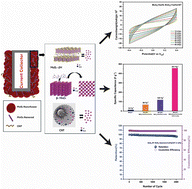
MoS2 nanoflowers, with their high surface area and substantial number of active sites in the layered structure, are promising candidates for charge storage. However, their poor electrical conductivity, severe sheet restacking, and cycling-induced degradation significantly hinder their rate capability and long-term stability. To overcome these limitations, MnO2 nanorods that possess pronounced pseudocapacitance are incorporated to provide complementary redox active sites and improve overall electrochemical performance. However, MnO2 nanorods suffer from volumetric fluctuations and sluggish charge transport, leading to rapid capacitance decay at elevated current densities. Introducing CNTs overcomes many of these challenges by forming a highly conductive, flexible network that improves electron transport and structural stability, synergistically boosting the performance of the MoS2/MnO2 composite to function as a supercapacitor electrode material. High performance supercapacitors require electrode materials that unify high capacitance, conductivity, and stability; such features are seldom found in a single component. Therefore, in this work, we first fabricated MoS2/MnO2 binary composites with varying MnO2 content and subsequently introduced 1 wt% CNTs into the optimized binary system to develop a MoS2/MnO2/CNT ternary composite via a facile hydrothermal route. The MoS2/MnO2/CNT composite offers numerous active sites and enhanced redox activity while ensuring rapid ion transfer efficiency to boost pseudocapacitance performance. Electrochemical characterization, performed in a 1 M KOH electrolyte, demonstrated that the MoS2/MnO2 (5 wt%)/CNT (1 wt%) electrode achieved a remarkable specific capacitance of 457 F g−1 at 0.15 A g−1 and retained 96% capacity with 100% coulombic efficiency over 2000 cycles. Notably, it delivers an energy density of 37 Wh kg−1 while maintaining excellent electrochemical stability and performance integrity. The synergistic interaction between the constituent components yields a defect-rich structure with high conductivity, structural stability, low charge transfer resistance, and improved cycling durability establishing the composite as a compelling candidate for advanced energy storage and seamless renewable energy integration.
 Please wait while we load your content...


