


In situ synthesis of bimetallic selenides on green porous carbon: density functional theory-proven electrocatalysts for efficient water splitting
 b
and
Yugender Goud
Kotagiri
*a
b
and
Yugender Goud
Kotagiri
*a
Abstract
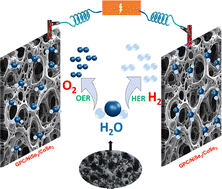
A dual synthetic engineering strategy is implemented to modify the electronic structure by integrating heterojunctions into a bimetallic selenide electrocatalyst employing a bead-like carbon skeleton framework within the catalyst. Here, we have synthesized a catalyst that is benign, porous, and graphitic, derived from the phytochemical extracts of the medicinal plant Vitex negundo Linn. Upon doping with a bimetallic selenide, it exhibits a conductive carbon layer on its surface. We also unveil a novel perspective on reducing metal ions using phytochemical extracts, wherein phytochemicals rich in long-chain polyphenols, flavonoids, lignans, terpenoids, and steroids function as both reducing agents and carbon scaffolds for the catalyst. Besides serving as a carbon support, it synergistically integrates cobalt and nickel selenides, enhancing catalytic activity while embedding metals within a graphene-like carbon matrix. The electrocatalyst exhibited notable performance in water splitting, achieving minimal overpotential and Tafel slopes for the HER and OER due to superior electrolyte diffusion characteristics attributed to its porous nature, also verified by density functional theory calculations as an enhancement in electronic structure modification and surface binding strength for reaction intermediates thereby playing a crucial role in improving electrocatalytic performance. These findings align with the mechanistic and experimental insights, further validating the significance of electronic structure modifications in enhancing catalytic efficiency for water splitting.
 Please wait while we load your content...


