


 PLATFORM UPDATE:


Biomineralized metal–organic frameworks targeting collagen for suppression of myocardial fibrosis and enhancement of cardiac function

Abstract
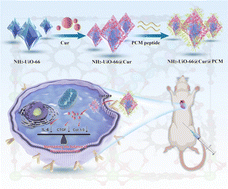
Myocardial fibrosis is a common pathological feature of numerous cardiovascular disorders, and plays a critical role in the development and progression of heart diseases. To address this, a novel delivery system (NH2-UiO-66@Cur@PCM) based on a biomineralized metal–organic framework (MOF) was ingeniously designed and constructed by post-modification synthesis. Meanwhile, first-principles density functional theory (DFT) simulations have been employed to confirm that the process of drug molecules integrating into the MOF matrix lattice is spontaneous and there are strong hydrogen bonds. Furthermore, in order to demonstrate the intervention efficiency of NH2-UiO-66@Cur@PCM in vivo under simulated myocardial fibrosis, NH2-UiO-66@Cur@PCM was effectively internalized after systemic administration, which effectively improved the myocardial microenvironment of mice by limiting the combined effect of inflammation and myocardial collagen, thus achieving an overall improvement in the microenvironment of mice hearts. Overall, these findings provide a solid theoretical basis and a new research direction for the construction of an innovative MOF material platform and the exploration of cardiovascular disease treatment strategies.
 Please wait while we load your content...


