


 PLATFORM UPDATE:


A hypervalent metal MOF catalyst as an avenue to go beyond heterogeneous Fenton-like processes for organic contaminant removal in water†
 bc
Salvador R. G.
Balestra,
cde
Nuria O.
Núñez,
f
A. Rabdel
Ruiz-Salvador
*cd
and
Menta
Ballesteros
*cg
bc
Salvador R. G.
Balestra,
cde
Nuria O.
Núñez,
f
A. Rabdel
Ruiz-Salvador
*cd
and
Menta
Ballesteros
*cg
Abstract
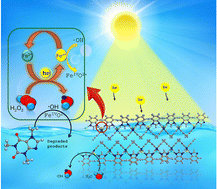
Metal–organic frameworks (MOFs) have recently been proposed as a plausible solution to the pressing issue of water scarcity and as a means of remediating contaminated water bodies. In light-assisted water treatment, they have so far only been exploited via the hydroxyl radical route, through Fenton-like processes. A new avenue is introduced here by the biomimetic conceptual design of MOF bearing hypervalent metal atoms for photocatalytic water treatment. We report a zeolitic imidazole framework (ZIF) material doped with iron (Fe-ZIF-7-III; UPO-4) synthesized via a novel mild treatment to stabilize photoactive hypervalent ferryl ions for the first time in a MOF for water treatment. The successful synthesis of the 2D material and the adequate incorporation of iron into the structure were demonstrated using X-ray diffraction (XRD), Fourier-transform infrared (FTIR) spectroscopy, and scanning electron microscopy (SEM). A simulation study analyzed the structure and stability of the Fe-ZIF-7-III material as well as the involvement of ferryl ions in the photo-Fenton-type process. Furthermore, the calculated band gap of this material shows its viability for use in photocatalysis using sunlight. This was confirmed by evaluating the photodegradation of caffeine, a model pollutant in water, without the assistance of hydroxyl radicals as indicated by a scavenger test. The recyclability test revealed that Fe-ZIF-7-III could be used continuously with effective catalytic activity, thus opening the door to the field of studying hypervalent metal MOFs not yet explored in water treatment.
 Please wait while we load your content...


