


 PLATFORM UPDATE:

Exploring the influence of anodization-derived nanotubular and honeycomb surfaces on the osteogenic behaviour of human MG63 osteoblastic cells
 ab
and
Fabio
Variola
*abcd
ab
and
Fabio
Variola
*abcd
Abstract
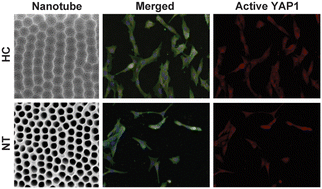
Nanoscale topography plays a pivotal role in modulating cellular behavior and has been a key parameter in the design of cell-instructive surfaces for biomedical applications. This study investigates the differential effects of two anodized titanium surfaces – a conventional nanotubular (NT) surface (∼75 nm diameter) and a two-tier honeycomb (HC) architecture – on the response of human MG63 osteoblastic cells. The HC surface, characterized by higher spatial entropy and a complex arrangement of smaller nanotubes (∼7 nm in diameter) clustered within larger domains (∼109 nm in diameter), significantly enhances early cellular functions, including proliferation, viability and upregulation of osteogenic markers (RUNX2, OSX, ALP), with the YAP/Hippo pathway likely implicated as a key mediator. This is evidenced by increased focal adhesions and nuclear YAP1 localization, underscoring the HC surface's capacity to promote cellular attachment and early differentiation. Conversely, the NT surface, with its more ordered nanotube array, induces comparable mineralization but yields higher-quality mineral deposits enriched with crystalline hydroxyapatite, suggesting greater efficacy in supporting mature mineral formation. These findings highlight the selective influence of nanotopographical features on early cellular dynamics versus long-term mineralization, offering critical insights into structure–function relationships governing MG63 cellular response to anodized titanium. By demonstrating the HC surface's prowess in early osteogenesis and the NT surface's strength in stable mineral deposition, this research advances the design of cell-instructive biomaterials tailored to distinct phases of bone regeneration, with implications for tissue engineering and biomedical implant technology.
 Please wait while we load your content...


