


 PLATFORM UPDATE:


Sustainable bubble-mediated dynamic triphasic antisolvent crystallization for magnesium sulfate nano–micro particles: precise size and morphology control

Abstract
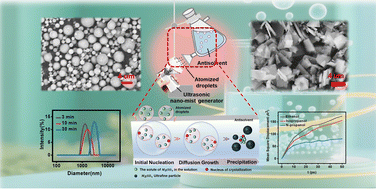
Particle ultrafine processing enhances material properties, but traditional antisolvent crystallization suffers from uneven size distribution, high energy use, and non-recyclable solvents. This study introduces Bubble-mediated Dynamic Triphasic Antisolvent Crystallization (BDTAC), a novel green method using vacuum-driven atomized droplets and bubble-mediated gas–liquid interfaces for ambient-temperature synthesis. Through optimized droplet inlet size, vacuum flow, and precipitation time, BDTAC achieves additive-free control of magnesium sulfate particles of 400–900 nm (fragmented) and 3–4 μm (hollow spheres), sizes 100× smaller than those obtained from traditional methods. Moreover, recyclable n-propanol yields smooth surfaces, and uniform flakes were formed with the help of ultrasonic treatment. The product particles exhibit excellent powder properties (θr < 35°) and retain magnesium sulfate hexahydrate's heat storage-compatible crystal structure. Importantly, BDTAC reduces energy consumption by over 3000 kJ per gram and minimizes waste generation by eliminating high-energy heating, mechanical stirring, and the use of surfactants or template additives. This contribution offers a scalable, energy-efficient approach for producing nano–micro particles in pharmaceuticals and energy storage, showing that precise particle design can be compatible with environmental sustainability goals.
 Please wait while we load your content...


