


Transforming waste into a bioactive resource: phenolic profile, antioxidant, and antimutagenic properties of pineapple (Ananas comosus) crown infusion
 a
Mariana Simões Larraz
Ferreira
*af
and
Ana Elizabeth Cavalcante
Fai
*ag
a
Mariana Simões Larraz
Ferreira
*af
and
Ana Elizabeth Cavalcante
Fai
*ag
Abstract
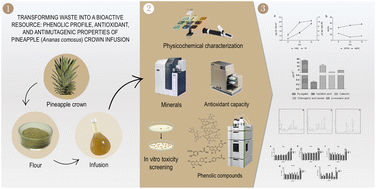
The pineapple crown accounts for 30% of the waste from pineapple processing. This study investigated the potential of pineapple crown, an upcycled agro-industrial by-product, for the development of infusions with health-promoting properties. The pineapple crown was processed into flour (PCF) to extend its shelf life as a food ingredient. It had a low moisture content (6.30), low pH (4.7) and low water activity (0.36). ICP-MS analysis confirmed the presence of essential minerals, including potassium, calcium and magnesium. The color of the PCF infusion was lighter and less reddish than that of the flour, but both samples were yellowish. HPLC/DAD analysis identified five phenolic compounds in the infusion, with pyrogallol, catechin and p-coumaric acid being the most abundant. The 15-minute infusion showed the highest total reducing capacity (TRC) (10.25 ± 0.29 mg GAE per 100 mL), total flavonoid (TF) (1.92 ± 0.055 mg CE per 100 mL), and antioxidant capacity. No significant differences were observed compared to the 10-minute infusion for TRC (9.90 ± 0.49 mg GAE per 100 mL), DPPH (192.48 ± 38.59 µg TE per 100 mL), and FRAP (320.26 ± 7.90 µg TE per 100 mL). A 10-minute infusion was determined to be the optimal preparation time. Toxicological screening showed that PCF was not mutagenic in the Ames test and had no cytotoxic effects on normal liver cells (HepG2 and FC3H). Notably, PCF showed dose-dependent cytotoxicity on gastric adenocarcinoma cells (HGC-27). PCF infusions offer a health-oriented beverage alternative that strengthens the role of upcycled agro-industrial material in food innovation and contributes to circular economy strategies in the food and pharmaceutical sectors.
 Please wait while we load your content...


