


Enzymatic bioprocessing of lychee juice for fructooligosaccharide enhancement and sustainable functional jelly formulation
 ab
and
Kitipong
Assatarakul
*a
ab
and
Kitipong
Assatarakul
*a
Abstract
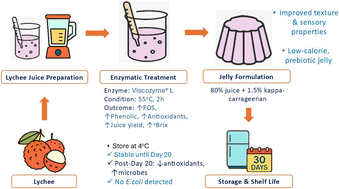
This study presents a sustainable strategy for enhancing the nutritional and functional quality of lychee juice and jelly through enzymatic bioprocessing. Lychee juice was treated with Viscozyme® L under varying incubation conditions (50–60 °C, 0–6 h) to enhance fructooligosaccharide (FOS) content and related bioactive properties. Optimal treatment (55 °C, 2 h) resulted in significant increases in FOS, total phenolic compound (517.53 ± 2.55 mg GAE/L), flavonoids (416.82 ± 0.42 mg QE/L), and antioxidant activity measured by DPPH (714.96 ± 4.02 mg TE/L) and FRAP (562.87 ± 0.67 mg TE/L), compared to untreated juice. Juice yield improved by up to 87.3% along with an increase in total soluble solid. The optimized juice was incorporated into lychee jelly formulations containing 70–80% FOS-enriched juice and 0.5–1.5% kappa-carrageenan. Textural analysis revealed that 1.5% kappa-carrageenan with FOS-enhanced 80% lychee juice produced jellies with superior springiness, cohesiveness, and gumminess, closely resembling commercial standards. These formulations also retained higher phenolics, flavonoids, and antioxidant activity than those with lower FOS-enriched juice content. Sensory evaluation with 50 panelists identified the 80% FOS-enriched juice + 1.5% carrageenan jelly as the most preferred across color, texture, sweetness, and overall liking. During 30 days of refrigerated storage, phenolics, flavonoids, and antioxidant activity declined significantly, accompanied by weakening gel texture, rising water activity, and microbial increases beyond acceptable limits after day 20, although no coliforms or E. coli were detected. This work highlights enzymatic hydrolysis and clean-label gelling as promising tools to develop functional prebiotic jellies that valorize local fruit resources, while also underscoring the need for improved preservation strategies to extend shelf life.
 Please wait while we load your content...


