


Enhancing millet-based analogue rice through sustainable cold plasma treatment: effects on mineral composition, structural, textural, cooking, and rheological properties

Abstract
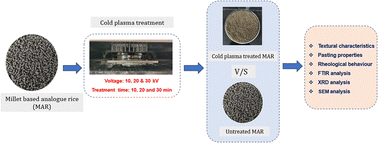
This study investigates the effects of cold plasma treatment on extruded millet-based analogue rice (MAR), formulated using pearl millet, sorghum, and parboiled rice. The treatment was applied at varying voltages (10, 20, and 30 kV) and time durations (10, 20, and 30 minutes) to evaluate its impact on physicochemical, cooking, and functional properties. The parameters assessed include color difference (ΔE), water absorption index (WAI), cooking loss (CL), water absorption ratio (WAR), cooking time (CT), and water solubility index (WSI). The results indicated that the highest treatment voltage (30 kV) and time duration (30 minutes) resulted in a minimized ΔE of 2.16 ± 0.30, reduced CT of 22.16 ± 0.37 minutes, decreased CL of 6.62 ± 0.28%, maximum WAI of 4.52 ± 0.27 g g−1, maximum WAR of 4.31 ± 0.26, and a minimum WSI of 2.16 ± 0.30 g g−1. Cold plasma treatment induced significant molecular modifications in MAR, evident from shifts in FTIR peaks and intensities, indicating structural alterations in starch molecules. Additionally, notable improvements in mineral composition, pasting behavior, and textural characteristics were observed, demonstrating statistical significance (p < 0.05). XRD analysis revealed reduced relative crystallinity in treated MAR, signifying improved structural stability. Microstructural analysis showed untreated MAR with a smooth surface and minimal porosity, while treated samples exhibited rougher, more porous surfaces due to moisture removal and starch rearrangement. These findings demonstrate that cold plasma offers a sustainable, non-thermal, and chemical-free processing alternative that improves the quality and functionality of millet-based analogue rice, aligning with current efforts toward environmentally friendly, energy-efficient, and nutritionally enhanced food technologies.
 Please wait while we load your content...


