


 PLATFORM UPDATE:

Powering up brewing: ohmic heating's effect on the extraction of key sensory compounds from hop pellets
 *a
Eduardo
Coelho,
ab
Rui M.
Rodrigues,
ab
António A.
Vicente
ab
and
Ricardo Nuno
Pereira
ab
*a
Eduardo
Coelho,
ab
Rui M.
Rodrigues,
ab
António A.
Vicente
ab
and
Ricardo Nuno
Pereira
ab
Abstract
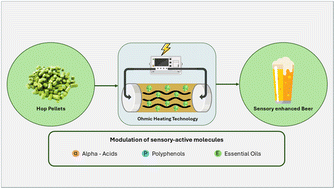
This study evaluates ohmic heating (OH) technology as an alternative to wort boiling in brewing and its impact on the extraction of key sensory compounds in beer—essential oils, alpha-acids, and polyphenols—from hop pellets. Conventional (C) boiling, performed using a water jacket, served as the control, while OH was applied at three electric field intensity ranges: 4–5 V cm−1 (OH5), 8–11 V cm−1 (OH11) and 22–26 V cm−1 (OH26). OH treatments influenced extraction/reaction kinetics when compared with C boiling, reducing total boiling time to 15 min, demonstrated by the absence of significant differences between the international bitterness units (IBU) of OH5 (86.38 ± 0.72), OH11 (89.21 ± 0.79) and OH26 (90.78 ± 2.83) after 45 min and the IBU of C (91.49 ± 4.98) after 60 min of boiling. Moreover, statistically significant (p < 0.05) higher IBU were observed for all OH conditions compared to C after 30 and 45 min of boiling. Kinetic differences were also observed for polyphenol concentrations, evident after 60 min of boiling, with C standing out with higher values (210.11 ± 6.01 mg L−1) over OH5 (165.97 ± 1.36 mg L−1), OH11 (177.09 ± 8.58 mg L−1) and OH26 (175.48 ± 12.66 mg L−1), suggesting that electric fields contribute to a faster decrease in polyphenol content against C boiling. Gas chromatography-mass spectrometry (GC-MS) analysis of essential oils revealed that longer boils reduce the levels of essential oils in both C- and OH-treated worts. Myrcene and humulene retention is not influenced by the chosen heating method. However, regarding linalool and geraniol, the higher electric field intensities of OH11 and OH26 resulted in a decrease of these essential oils' levels, while C boiling and OH 5 boiling, promoted their retention in the final beer. Results suggest that OH treatments could be employed in brewing as a novel boiling technology. OH promotes uniform and rapid heating, faster bitterness development and increased hop utilization, less haze and astringency, and potential modulation of the hoppy flavours and aromas in beer. OH further demonstrated its potential to reduce processing time and energy consumption, highlighting this technology as a promising and sustainable alternative to conventional boiling methods.
 Please wait while we load your content...


