


Recent advances in chemical upcycling of plastic waste: microwave-assisted heating and heterogeneous catalysis
 ab
and
Gillian
Collins
*ab
ab
and
Gillian
Collins
*ab
Abstract
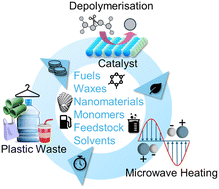
The chemical upcycling of plastic waste offers a sustainable pathway to transform discarded polymers into valuable chemical feedstocks and fuels. Among emerging approaches, microwave (MW)-assisted heating has gained significant attention for its ability to deliver rapid, uniform energy input, dramatically reducing reaction times compared with conventional thermal methods. When coupled with heterogeneous catalysis, MW irradiation can lower activation barriers for depolymerisation, enhance product selectivity and reduce overall energy demand. Heterogeneous catalysts also provide advantages in recovery, reuse and process scalability, making them attractive for industrial adoption. Recent research has focused on tailoring catalyst composition, structure, and surface properties to optimise MW–catalyst interactions across a wide range of polymer types, including polyesters, polyolefins, polystyrene, polyamides and polyvinyl chlorides. This review summarises the fundamental principles of MW-assisted catalysis and critically examines recent advances in catalyst design, reaction optimisation and mechanistic understanding.
- This article is part of the themed collections: EES Catalysis Recent HOT articles and EES Catalysis 2026 Review Articles
 Please wait while we load your content...


